
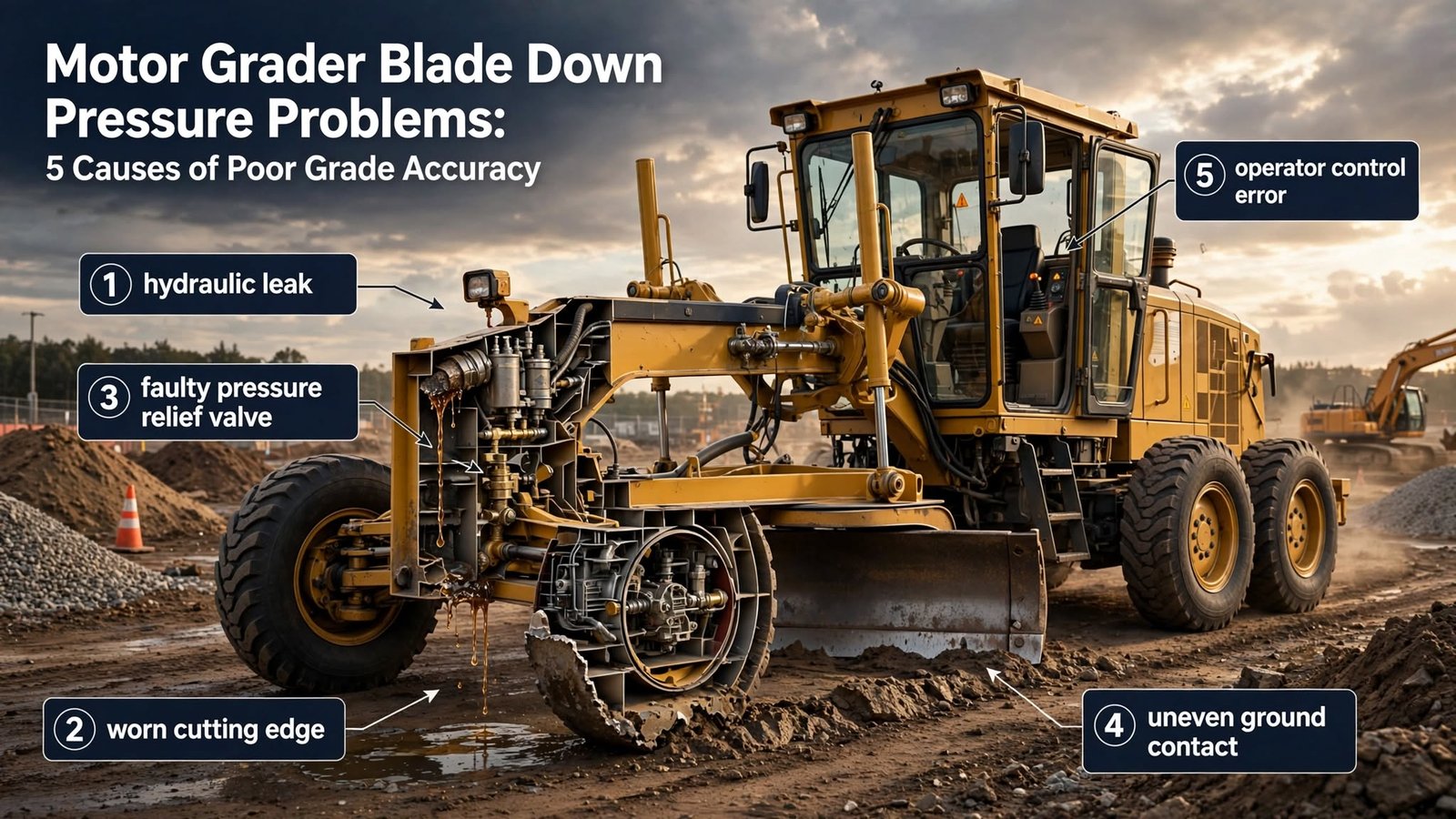
Motor grader blade down pressure problems begin when the blade cannot press into the ground. The blade must hold a constant depth. When the blade loses down pressure, grade accuracy fails. The surface gets wavy. The operator makes extra passes. The project falls behind schedule. This post covers motor grader blade down pressure problems across 5 causes. You will learn why the blade floats. You will learn why the blade digs unevenly. You will learn the fixes. Apply these motor grader blade down pressure problems solutions to your machine. Hold grade. Finish faster.
This down pressure loss shows up in several ways. The blade rides over hard spots. The blade bounces on rough ground. The blade cuts deeper on one side. The blade loses depth when the machine speeds up. Each symptom points to a specific cause. The motor grader blade down pressure problems do not fix themselves. The problems get worse with use.
Table of Contents
Worn Cutting Edge and Moldboard
The first of the motor grader blade down pressure problems is a worn cutting edge. A sharp edge bites into the ground. A worn edge skims across the surface. The blade loses down pressure because the edge cannot penetrate. The machine weight pushes down. The dull edge slides sideways. The blade floats over the material.
Check the cutting edge thickness. Measure at the bolt holes. Replace the edge when thickness drops below one inch. The motor grader blade down pressure problems disappear with a new edge. A new edge costs 100 to 800 dollars. The fuel savings from proper cutting pay back the cost in weeks.
A contractor noticed wavy gravel roads. The operator made five passes per road. The blade kept riding over the hard crust. A new cutting edge solved the motor grader blade down pressure problems. Pass counts dropped from five to three. Fuel consumption dropped by 20 percent on that route.
The moldboard condition also matters. A bent moldboard changes the blade angle. The cutting edge does not contact the ground evenly. One side cuts deep. The other side floats. Inspect the moldboard for bends and cracks. Straighten minor bends. Replace moldboards with deep bends. The motor grader blade down pressure problems often trace back to a bent moldboard.
Incorrect Blade Pitch Angle
The second of the motor grader blade down pressure problems is incorrect pitch. Pitch controls how the edge meets the ground. Too much backward pitch lifts the edge. The blade skims the surface. Too much forward pitch digs the edge. The blade stalls the machine. Both extremes cause poor grade accuracy.
Set pitch based on the material. Sand needs 2 to 4 degrees backward pitch. Clay needs 3 to 5 degrees forward pitch. Gravel needs 0 to 2 degrees forward pitch. Dirt needs 1 to 3 degrees backward for dry ground. Wet dirt needs 2 to 4 degrees forward. The motor grader blade down pressure problems fade when pitch matches the material.
A highway crew fought grade accuracy problems on clay subgrade. The operator ran zero pitch. The blade glazed the surface. The blade could not cut. A change to 4 degrees forward pitch fixed the motor grader blade down pressure problems. The blade cut cleanly. The subgrade passed inspection on the first check.
Check the pitch indicator every shift. Vibration changes the pitch setting. The indicator drifts over hours of work. The operator corrects the pitch before the drift affects grade. These grading issues start small. The problems grow if the operator ignores the indicator.
Hydraulic Cylinder Internal Leaks
The third of the motor grader blade down pressure problems is hydraulic cylinder leakage. The lift cylinders hold the blade at the set depth. Internal seals keep the oil on one side of the piston. Worn seals let oil bypass the piston. The blade drops under load. The blade rises when the load changes. The operator cannot hold a constant depth.
Test the cylinders for internal leaks. Raise the blade to full height. Stop the engine. Watch the blade for 10 minutes. A blade that drops more than one inch has leaking seals. These hydraulic issues continue until the seals get replaced.
Rebuild the cylinders with new seal kits. A seal kit costs 150 to 300 dollars per cylinder. A new cylinder costs 1500 to 2500 dollars. Rebuild first. The motor grader blade down pressure problems disappear when the seals hold pressure. The blade stays at the set depth. Grade accuracy returns.
A grader had blade drift on every pass. The operator corrected the blade height constantly. The finish grade was three quarters inch off target. A cylinder rebuild fixed the motor grader blade down pressure problems. The same operator held quarter inch tolerance after the repair. The rebuild cost 400 dollars. The grade improvement saved 8000 dollars in rework.
Worn Circle and Drawbar Components
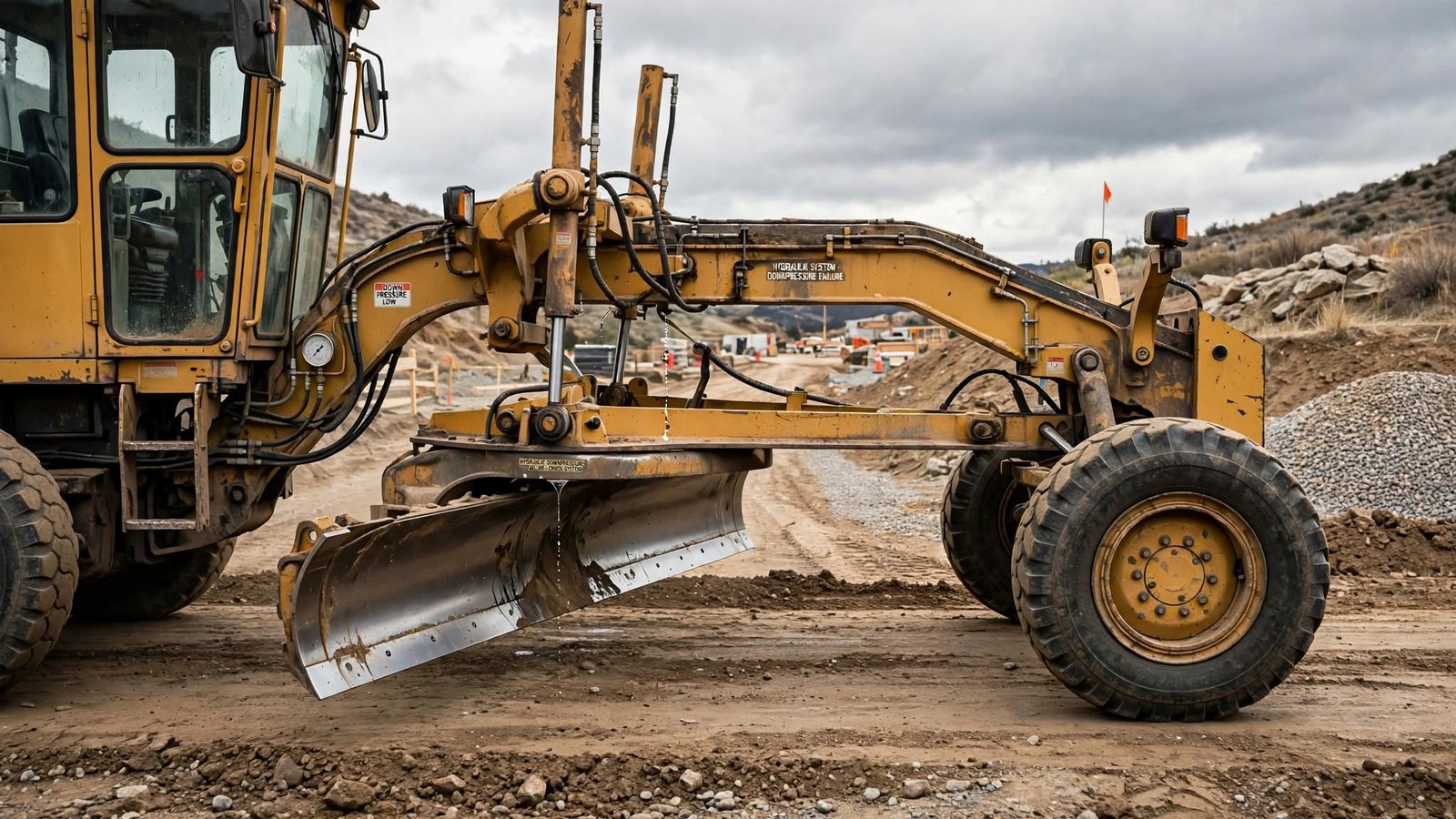
The fourth of the motor grader blade down pressure problems is circle and drawbar wear. The circle supports the blade. The drawbar connects the circle to the frame. Wear strips and bushings hold these parts tight. Worn strips let the circle drop. Worn bushings let the drawbar move. The blade loses down pressure when the circle shifts.
Check the circle side play. Push the blade side to side with a pry bar. More than one inch of movement means worn parts. Check the wear strips under the circle. Measure the strip thickness. Replace strips at the wear limit. The accuracy loss reduces when the circle stays tight.
Check the drawbar pivot bushings. Loose bushings let the drawbar rock. The rocking changes blade angle. The blade cuts unevenly. Replace worn bushings. The parts cost 50 to 200 dollars. The labor takes four to six hours. The improved grading justifies the repair cost.
A county fleet had grade accuracy complaints on three graders. All three machines had worn circle wear strips. The blades shifted during grading. The operators made constant corrections. New wear strips and shims fixed the motor grader blade down pressure problems. Grade accuracy improved by 50 percent. The operators finished routes faster.
Machine Weight and Ballast Issues
The fifth of the motor grader blade down pressure problems is machine weight. The blade needs weight to push into the ground. A light machine floats over hard material. A heavy machine cuts through. The front axle carries the blade load. Weight on the front axle creates down pressure.
Check the machine ballast. Some graders use front counterweights. Some graders use liquid ballast in the tires. Missing ballast reduces down pressure. This floating effect appears on hard ground. Add the manufacturer recommended ballast. The blade bites into the material. Grade accuracy improves.
Tire pressure also affects blade down pressure. Low tire pressure increases the footprint. The machine sits lower. The blade angle changes. High tire pressure reduces the footprint. The machine sits higher. The blade angle changes again. Check tire pressure weekly. Match the pressure to the sidewall specification. These issues reduce when tire pressure stays correct.
A mining crew fought grade accuracy on haul roads. The grader had no front ballast. The blade floated over compacted gravel. The crew added front counterweights. The blade cut into the surface. The motor grader blade down pressure problems disappeared. The haul road grade improved. The trucks rode smoother.
Daily Operation & Tracking
Now let us connect the troubleshooting to daily operation. Start every shift with a blade inspection. Check the cutting edge thickness. Check the moldboard for bends. Check the blade bolts. Tighten loose bolts. Replace missing bolts. The motor grader blade down pressure problems start at the blade.
Check the pitch indicator. Set the pitch for the material. Test the pitch on a short section. Watch the material roll. Adjust the pitch until the roll is smooth. These grading errors reduce with correct pitch. Test the lift cylinders. Raise the blade. Stop the engine. Watch for drift. A blade that drops has leaking seals. Schedule the cylinder rebuild. The depth fluctuations continue until the seals get fixed.
Check the circle side play. Push the blade with a pry bar. Measure the movement. More than one inch means worn parts. Replace the wear strips and shims. The drifting reduces when the circle stays tight. Check the machine ballast. Add front counterweights if missing. Check tire pressure. Adjust to specification. Blade floating reduces when the machine weight matches the job.
Track grade accuracy on every job. Measure the finished surface. Compare to the target elevation. Note the pass count. Note the fuel consumption. The motor grader blade down pressure problems show up in these numbers. A sudden drop in accuracy points to a specific cause. Use the five causes above to find the problem.
Real-World Results
One contractor implemented this motor grader blade down pressure problems checklist. Grade accuracy improved from plus or minus one inch to plus or minus quarter inch. Pass counts dropped by 30 percent. Fuel costs dropped by 25 percent. Rework dropped to near zero. The contractor saved 40000 dollars in one season.
Conclusion
The troubleshooting steps above cover the main causes. Worn cutting edges. Incorrect pitch. Hydraulic leaks. Circle and drawbar wear. Machine weight issues. Each cause has a specific fix. Each fix improves grade accuracy. Each fix saves money.
Test for these issues on your machine. Run a test pass. Watch the blade. Feel the machine. Note the blade behavior. A floating blade points to a dull edge. A bouncing blade points to incorrect pitch. A drifting blade points to cylinder leaks. A shifting blade points to circle wear. A skating blade points to weight issues.
Now go check your blade. Measure the cutting edge. Check the pitch. Test the cylinders. Check the circle play. Check the ballast. Fix the motor grader blade down pressure problems today. Your grade accuracy will improve. Your projects will finish faster. Your customers will notice the difference.