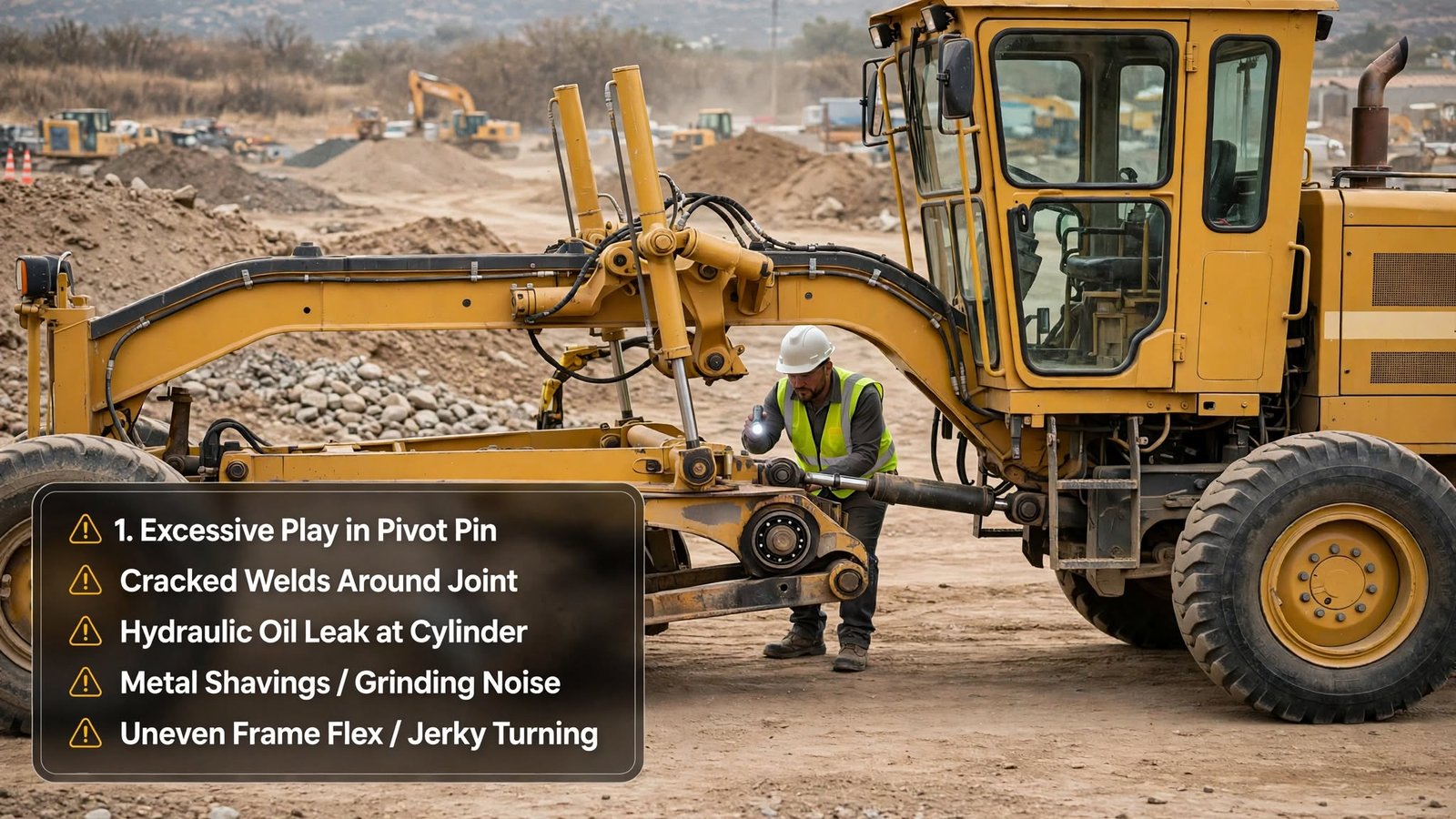
Articulation Hitch maintenance is key to your machine’s steering. Sometimes people overlook small issues and then one day you will feel your machine is not turning correctly. At this point it is usually realised that something is badly wrong. Unfortunately by now the inexpensive solution has passed you by. You are faced with a potentially large expense for a joint replacement – prices can vary from $15,000 to $35,000 and again this does not include time that your machine may need to spend out of action to await spare parts.
An Articulation Hitch links two frames; the front frame (which houses your blade) and front axle, to the rear frame which contains your engine, cab and tandems. It is subject to the greatest mechanical stress as it must support the total weight of the machine and also deal with side forces generated during grading. For these reasons it is important to recognise early symptoms of an issue. Below are five subtle indicators that your Motor Grader Articulation Hitch is in difficulty and that frame failure is imminent.
Table of Contents
Build-up of Dirt/Foreign Matter
Contrary to popular belief, build-up of dirt, stone and/or dry mud around an Articulation Hitch is not in fact typical of good working conditions. It is often ignored as it can resemble the dirt that is common on construction sites.
Build-up of foreign matter around an Articulation Hitch causes reduced joint mobility. As a result, steering cylinders must exert greater force to turn the frame. This in-turn places extra strain on both the steering cylinders and the joint. Worst case, the joint can even lock when the machine is turning – creating a potentially dangerous situation irrespective of speed. Fortunately, this issue is easily remedied by simply removing the build-up. However, if you are not routinely maintaining the area then you are allowing your Articulation Hitch to function in conditions for which it was not designed.
Grease Leakage from the Joint
Whilst you do apply grease to Articulation Hitch pins, ideally this should be contained within the joint and then be forced out of the seals in a pressurised manner. However, if you observe that grease is leaking from around the pin seals without pressure being generated, then it is not effectively lubricating the wearing surfaces and is in fact escaping.
Typically, this is caused by a worn bushing (or sleeve). Within the Articulation Hitch, the sleeve is a replaceable component which forms a wearing surface and shields the costly main bore from the reciprocating pin. As the sleeve wears away, the gap between it and the bore widens. Consequently, the grease escapes via this enlarged gap as it no longer adequately lubricates. Should this issue be ignored then the pin itself will begin to wear the bore. Clearly, at this point you will no longer be replacing just a sleeve but will be required to replace an entire housing.
Noise whilst Turning
Turn your steering wheel and articulate the frame. Ideally, your Articulation Hitch should operate both smoothly and silently. You certainly do not want to hear knocking, squeaking or thudding noises.
Such noises are indicative of either worn bushings or pins. Once the sleeve has worn beyond acceptable levels, the pin is able to move within the bore, despite there being excessive clearance. This causes the noises. Furthermore, the frame becomes incorrectly aligned – reducing grading accuracy and hastening tyre wear. Equally importantly, the knocking is the Articulation Hitch alerting you to the fact that it is no longer achieving a good fit and therefore your machine is becoming unstable.
Frame Movement
To detect frame movement, either use a bar or your hands to investigate the Articulation Hitch. Should you be able to observe or sense such movement then you will realise that this critical joint can no longer be saved by merely re-greasing.
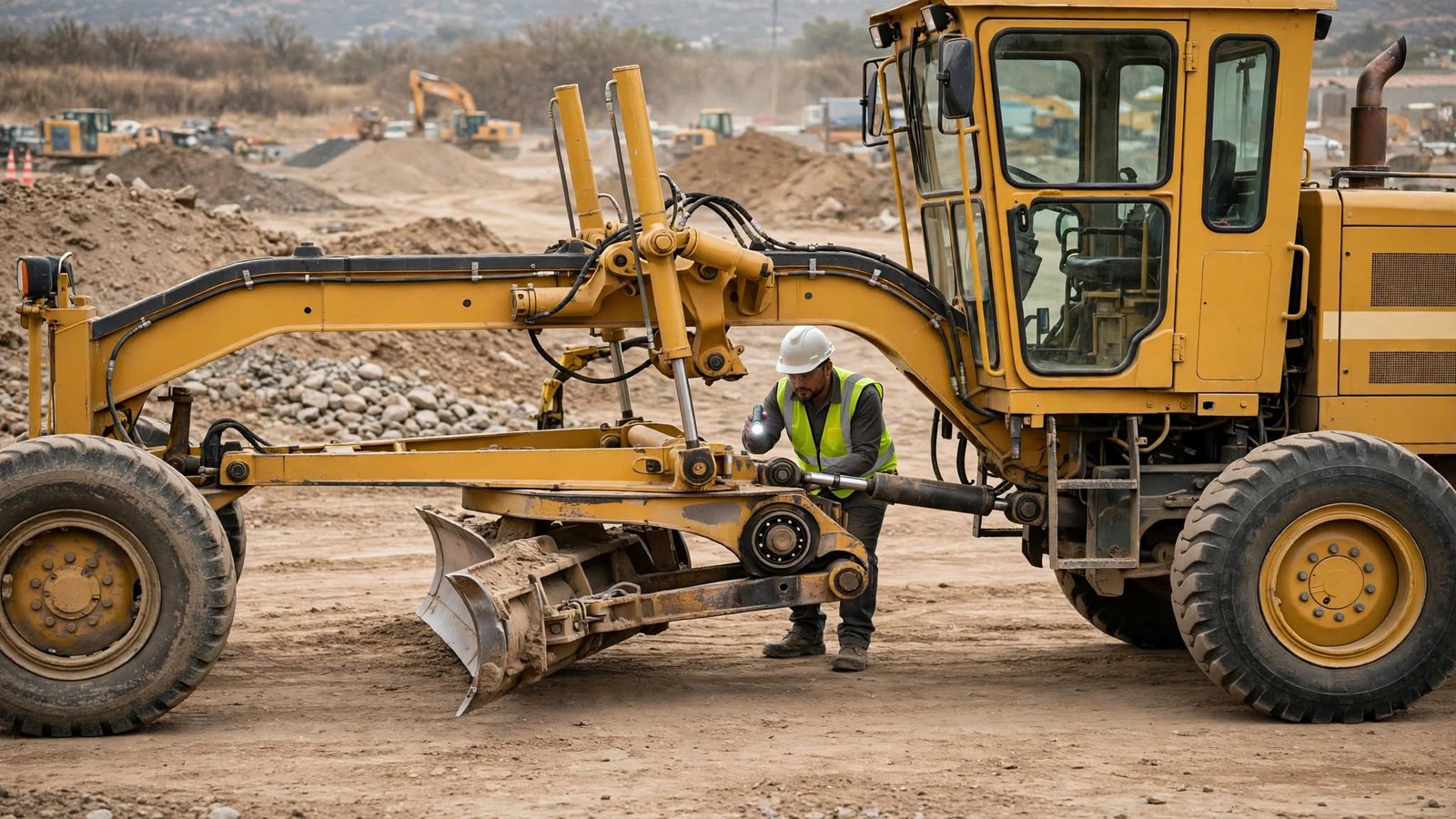
As a general rule, if the frame can be moved by in excess of 3mm at one metre then the bushing or sleeve is likely to be excessively worn. Once frame movement occurs, further complications are likely to arise. The loose fit allows the pin to continually strike the bore. This in turn results in more rapid wear of both components. Incorrect frame alignment also occurs. Steering then feels less responsive and overall, your machine begins to feel loose. Often, people only recognise frame movement at this stage and in reality, unacceptable wear has been occurring for some time.
Pin Scoring
Whilst investigating the exterior of the Articulation Hitch, also examine the pins. If the pins are scored or suffer from galling then this suggests that for some time the Articulation Hitch has not been adequately lubricated or that the bushing has been worn.
Metal to metal contact between pins and bore occurs once lubrication has been compromised. Again, this does not occur suddenly. It can be caused by poor lubrication or indeed by a previously worn bushing which has not been recognised. Should a pin become scored then, if you simply replace the bushing and continue to use the same pin, the new bushing will itself wear more quickly. Therefore, if a pin is scored, it must be replaced along with the sleeve.
Why Regular Grease Application is Vital
What differentiates a well maintained machine from one that is sent off to the workshop is regular (daily) greasing of all Articulation Hitch fittings. It is not sufficient to grease periodically or sporadically. Poor lubrication is by far the principal cause of premature wear on your equipment.
Continue to grease until fresh grease is evident at the seals. Apply NLGI #2 EP grease which contains extreme pressure agents and is suited to high stress, low speed joints. Merely applying a couple of pumps of grease and then leaving your machine is insufficient. Effective lubrication can only occur if existing grease is displaced to allow new grease to adequately lubricate the wearing surfaces.
Furthermore, the steering cylinders which manipulate the Articulation Hitch should also be regularly examined. Investigate for rod scoring, seal leakage and loose pin attachment. Should a steering cylinder fail then you will lose steering control – something best avoided, particularly if you are travelling at speed on a road shoulder. Again, insidious contamination can occur. Even minute imperfections on a steering cylinder rod can allow foreign matter to enter the cylinder, much like issues addressed in circle drive maintenance.
The Locking Pin – Small but Mighty
Finally, there is another element of an Articulation Hitch which is generally not considered by most people, yet is important. The locking pin is used to firmly fix the front and rear frame sections together during transportation (for example by truck or rail), and also when a mechanic is working close to the joint.
It passes through pad-eyes on the front and rear frames and secures the frames. Problems can occur if the locking pin is absent, faulty or is jammed. To un-jam a locking pin, one person can steer the machine to locate a point at which there is no pressure on the pin and a second person can then ease it out. Obviously, this is not ideal activity to carry out when your machine should be on a trailer.
Ensure that a locking pin exists and that its retainer is in order. Confirm that the pin can move freely when frames are correctly aligned. As with many aspects of machine maintenance, this is both quick and inexpensive to investigate and can help to avoid much hassle.
Basic Yet Effective Maintenance
Whilst no elaborate regime is necessary, regularity is important. Below is a realistic example of both daily and weekly maintenance for an Articulation Hitch.
In the morning, prior to commencing grading, firstly clean the area. Remove foreign matter including dirt and stone. Secondly, grease all fittings and continue to do so until fresh grease is extruded from the seals. Next, turn the steering wheel for half a minute and listen to the operation. Finally, walk round your machine and check for leaks or rod scoring on the steering cylinders. Also confirm that the locking pin is fitted and securely positioned.
Weekly, kneel or crouch under your machine and use a light source to further inspect the assembly. Assess frame movement. If possible, also check pins. Examine the frame area surrounding the unit for cracks. Lastly, ensure that all bolts are correctly torqued. If any irregularities are identified then bring them to someone’s attention. Avoid delaying action until a breakdown occurs.
At each service, assess frame movement and evaluate bushings. If movement is nearing unacceptable levels then arrange for repairs. Clearly, bushing replacement is considerably less costly than joint replacement, which is likely to be required if an Articulation Hitch fails.
Thus, no specialist equipment or costly testing procedures are needed. All that is essential is a grease gun, torch and the commitment to dedicate just five minutes each day to maintaining the Articulation Hitch – the central component of your machine.
In Summary
Generally, problems do not occur suddenly. Rather, they tend to develop as a result of irregular greasing regimes, failure to clean away foreign matter and/or lack of response to any noises. Usually by the time blade deviation and/or noticeable knocking occur, the opportunity for a low-cost remedy has already lapsed and you are facing the prospect of joint replacement.
Although the above indicators are relatively straightforward to recognise, establishing good daily maintenance practices around cleaning, grease application, noise detection, frame movement assessment and pin examination will ensure that your Articulation Hitch continues to provide a good fit. This in-turn guarantees that frame alignment is maintained and that your machine continues to perform efficiently. Such good maintenance is eminently cost effective, offering value for money year on year.